Go to a hospital emergency department straight away if back or neck pain comes with:
- Loss of control of your bladder or bowels, or numbness in the groin or inner thighs
- Weakness in the legs or arms that is getting worse quickly
- Clumsy hands or a change in balance and walking
What Is Spinal Degeneration?
Spinal degeneration describes gradual wear in the structures of the spine. The discs lose height and water content (thoái hóa đĩa đệm), the small facet joints become arthritic, and the surrounding ligaments thicken. You may also see it called spondylosis, spinal arthritis or degenerative disc disease.
Some degeneration is a normal part of aging, and many people with changes on imaging have little or no pain. Symptoms usually appear when the spine stiffens, loses mobility, or begins to crowd a nerve.
Bone Spurs (Gai Cột Sống) and Spinal Stenosis (Hẹp Ống Sống)
Bone spurs and spinal stenosis are not separate diseases. They are two ways spinal degeneration can show up.
Bone spurs (gai cột sống) are small growths of bone that form along the edges of the vertebrae as the spine responds to wear. Many cause no symptoms. They become a problem when they narrow the space around a nerve.
Spinal stenosis (hẹp ống sống) is a narrowing of the spinal canal or of the openings where nerves exit. Thickened ligaments, bone spurs and bulging discs can all contribute. In the lower back, a typical sign is leg pain or heaviness when walking or standing that eases when you sit or bend forward.
Lower Back vs Neck Degeneration
Lumbar degeneration (thoái hóa cột sống thắt lưng) often causes low back stiffness and aching, and can lead to stenosis and leg symptoms.
Cervical degeneration (thoái hóa cột sống cổ) often causes neck stiffness, reduced head turning and tension into the shoulders, sometimes with arm or hand symptoms.
Common Symptoms of Spinal Degeneration
- Stiffness in the low back or neck, often worse in the morning (cứng khớp buổi sáng) or after sitting
- A deep, aching pain that comes and goes, sometimes becoming long-term back pain (đau lưng mãn tính)
- Reduced ability to bend, twist or turn your head
- Pain, numbness or heaviness in the legs when walking or standing, easing when you sit
- Tingling or weakness in the arms or hands with neck degeneration
What Causes Spinal Degeneration, and Who Gets It?
Age is the main factor, but lifestyle shapes how quickly it develops and how much it affects you. Risk factors include long hours of sitting, repeated heavy lifting, past spinal injuries, excess body weight, smoking and low physical activity.
In our clinic, the first signs of spinal degeneration often appear in a patient's 30s and become more noticeable in their 40s and 50s. Degeneration is progressive, which means it tends to advance over time. That is why it pays to address stiffness and pain early, and to keep the spine moving well for the long term.
Your First Visit: Consultation and Examination
Your first visit starts with a one-to-one consultation. The doctor listens first, then asks how the problem started, how it feels and what your goals are.
Next is a thorough examination focused on your problem. For spinal degeneration this includes orthopedic and neurological testing, checks of how your spine moves, and stability testing to look for slippage between vertebrae (spondylolisthesis). It shows us:
- Which area of the spine is involved
- Whether a nerve is being irritated or crowded
- Whether non-surgical care is a good fit for your condition
Depending on what the examination shows, treatment may begin on the same day.
Do I Need an X-Ray or MRI?
If you already have an X-ray or MRI, please bring it.
For spinal degeneration, an X-ray is especially useful because it shows disc height, bone spurs and spinal alignment, and the doctor often recommends one. Please do not book a scan on your own before your visit. Without an examination it is easy to image the wrong area or choose the wrong test. When imaging is needed, the doctor will refer you.
Non-Surgical Care for Spinal Degeneration at True Core Wellness
The doctor builds your plan from three core parts, adjusted to your examination:
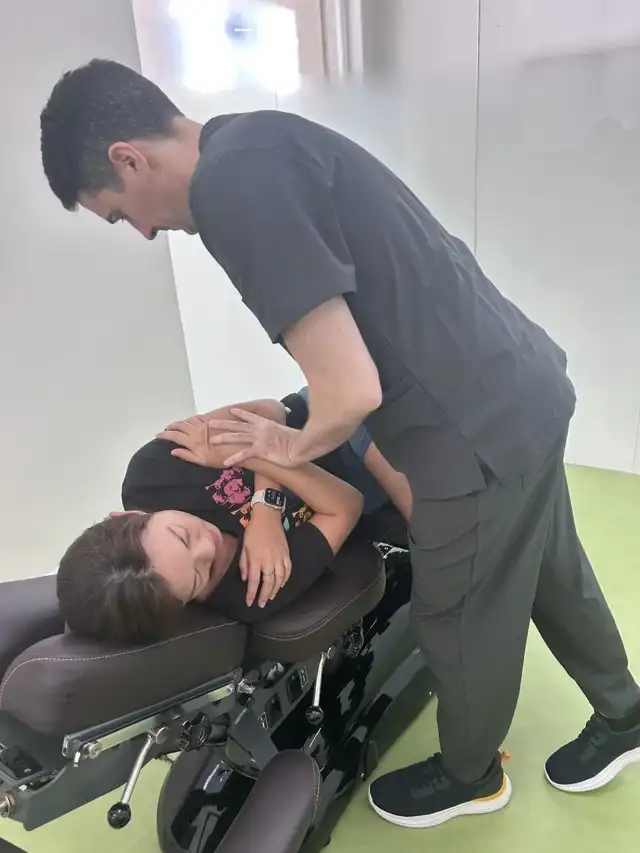
- Chiropractic adjustments (nắn chỉnh cột sống). Techniques are chosen to suit a degenerated spine and aim to restore movement to stiff joints.
- Physiotherapy (vật lý trị liệu). Depending on your needs this may include laser therapy, shockwave therapy, or instrument-assisted soft tissue work (IASTM) for tight muscles and tissues.
- Rehab exercises with mobility work. Guided exercises improve how your spine moves, then build the strength and control that support it in daily life.
Realistic Goals: Better Function, Less Pain
We are honest with every patient: we cannot erase degeneration, but the way your spine functions can still improve. The goals of care are less pain, better mobility and better day-to-day function.
What Does a Typical Care Plan Look Like?
A typical plan is 3 to 4 visits per week for 12 visits, after which the doctor reassesses your progress. Because degeneration is a long-term condition, maintenance care of at least once a month may be recommended to help keep your spine moving well.
When We Refer You to a Specialist
If progress is limited by visit 8 to 10, or the pain is too severe for conservative care, we refer you for injections or a surgical consultation within our network of trusted hospitals.
 Related serviceBack & neck painTreatment for pain from posture, desk work and degeneration.
Living Well With Spinal Degeneration
- Keep moving: walking, swimming and your home exercises help a stiff spine more than rest
- Break up long periods of sitting every 30 to 45 minutes
- Lift with your hips and knees, and keep heavy objects close to your body
- Maintain a healthy body weight and avoid smoking

Medical Director of True Core Wellness Chiropractic Clinic. Updated 10/2026. View profile
This page is for general information and does not replace an individual medical examination.